Friday, May 17, 2013

Play Ball


Baseball is life in the Dominican Republic, it is the dream of every boy and his family, it is the favorite pastime, and men and boys of all ages play and practice weekly, if not daily. But “the dream” of playing in the MLB in the United States is a far journey that only a handful of players will actually achieve. Yet, a culture of poverty and a few amazing success stories foster a widespread belief that a baseball contract is the escape from poverty, for a player but also his family and friends. There are undoubtedly positives and negatives to the culture and system of baseball in the DR but Dominicans seem to have little fear of the fairly obvious downfalls of starting children as young as 10 in serious baseball programs in dreams that they will make it to the Major Leagues.
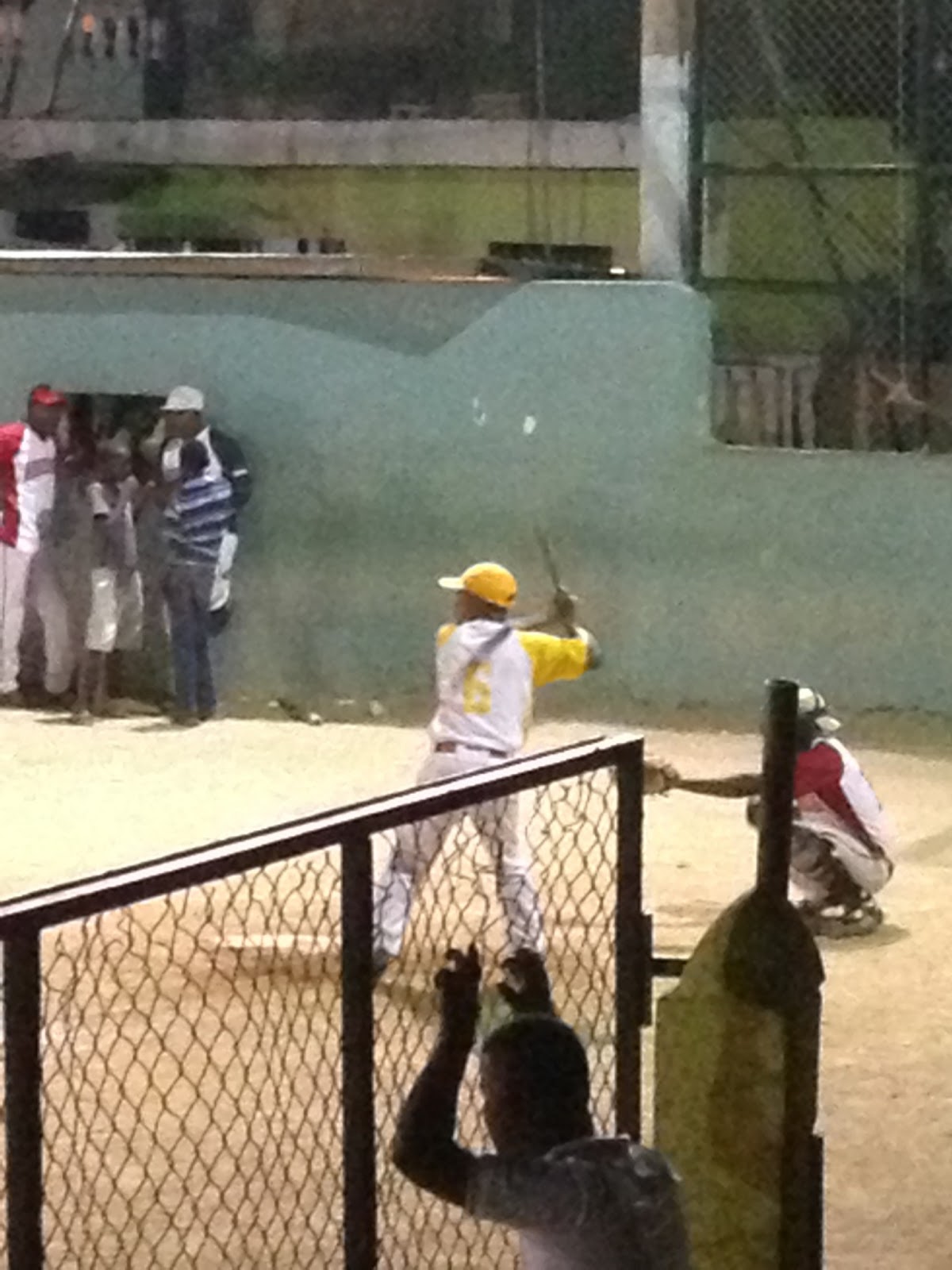
The American baseball training program “I Love Baseball” (ilovebaseball.org) reports that in 2006 the MLB was investing $84 Million in potential Dominican players and training programs and all 30 MLB teams currently have academies in the DR.  “20 current MLB players were featured on the Dominican Republic’s World Baseball Classic roster.  Their combined 2013 salaries amount to $104,590,000,” (Jessop, www.forbes.com, 2013). While these 20 players are the “dream,” they had to endure a lifetime of intense training only to be signed at a fraction of American players’ contracts. In addition to the 20 major league players, 25% of minor league players are Dominican, (Jessop, 2013). For many Dominican players, playing for a MBL sponsored Dominican or US based minor league represents a middle or upper-class life in the DR.

Young boys with interest in baseball enter training programs with private coaches and managers who have contracts for a portion of the future signing with a professional academy. The legal percentage a coach or manager can take is 30% although there are many coaches and managers who take advantage of players with contracts for higher percentages and/or charge players for training programs. Boys enter these programs as young as 10. Boys cannot legally be signed into a MBL academy until the age of 16, but may pass to more professional or higher level training programs. The best type of coaches sign players but do not charge a practice fee and often purchase supplies and equipment for young players out of pocket. Like the players’ parents, coaches are betting on these young athletes to “pay off” and get signed. In many cases when children enter training programs, their coaches become their main caregiver.  “I Love Baseball” estimates that only 2-5% of players in training programs will get signed into an academy. If they are signed, they will join a MBL farm league academy. Contracts are typically $5,000 - $25,000US (of which trainers take 30%) but many academies also pay players bonuses for signing, in addition, players receive stipends while in the academy of $600 - $1,000 a month (ilovebaseball.org). For the few teens who make it to a farm league academy, the contract, bonuses, and monthly stipend can change their lives. In addition to MBL farm leagues, other organizations and groups have “academies” that may feed into US AAA or farm leagues, although the chances are even slimmer of continuing to a more advanced team. Once signed into an academy, a young player still has 7 levels to complete: DSL, Rookie League, High Rookie League, Low Class A, High Class A, Double A, and Triple A before a US MLB team (ilovebaseball.org).

Baseball is every young boys’ dream, and the dream of many parents too, but could the baseball system be another form of child abuse and child labor? While the youngest players, 10-18 are not paid in cash, they are working for future payout and are arguably paid in equipment and food. Parents often with go their responsibilities once a son has been taken on by a coach, suddenly claiming to not have the money to pay for necessities. In addition, many young boys work to pay coach fees and purchase equipment. In this situation, players practice and work every day leaving little or no time for school. Young athletes who spend their time practicing everyday from the age of 10 are left with very little education to fall back on when they no longer play.

The system of baseball, especially the high number of boys in lower level training programs compared to the small few who sign contracts into baseball academies and the even smaller number who are awarded baseball careers, leave many boys without a completed education and/or working at a young age to pay coaches and for equipment.  While there are negatives many stories and studies show, playing on a team, for a collective goal, and practicing daily can teach important life skills, confidence, and determination… skills and characteristics that many children in the Dominican do not learn in public school or at home. The pros and cons of a youth baseball system are clear, the community needs to weigh them without bias to ensure that children are protected and that baseball and family pressure to support them financially do not outweigh the importance of an education.

Sunday, May 12, 2013

Rebuilding

This blog has sat unwritten for some time now... as many of you know, I have been on a roller coaster of health and while my body was fighting my heart and mind seemed to be lacking. For several weeks, I fought off little colds, flues, and icky feelings... along with them feelings of blah, feeling unsure about pretty much everything, not wanting do anything and needing to do something at the same time. 

All of this up and down let to my immune system finally giving in... Two Tuesdays ago I was admitted into the hospital with infected kidneys, extremely high white blood cells, and dehydration. It sounds crazy, but the realization that I was not crazy... helped. Not only did I accept that my body and mind hadn't been playing games but other people realized it too. As self centered it feels to put to words, the outpouring of support and love reminded my tired body and mind that I am not alone. Being without your family and friends, not matter how many new friends or family you find in your placement, is hard and it is even harder when your not feeling yourself.

After a whole week of back to work, I have, for the first time in my life, seen how much time a sick body really needs to mend. I am still over a week later feeling the exhaustion that comes after a few days in the hospital and weeks of a weak immune system. In true Holst fashion, I am sure my "go get'm" ran back to work a bit to fast! 

With trip home in 18 days and counting... my eyes are "on the prize" of a few weeks of vacation. I don't know how much R'n'R will happen but there will be plenty of soul fixing time with family, sisters, the cutest God Baby, and my pup. 

One of my favorite places to enjoy the beach. After a big storm it looked worse for the wear,
but like the rest of us, after some TLC it was put back together even stronger.
Despite the tumbled beach, the water in the distance was prettier than ever.

Sunday, April 21, 2013

April - Child Abuse Prevention and Awareness


April is Child Abuse Prevention and Awareness month. To fulfill both Prevention and Awareness, Caminante is hosting and participating in events to educate children and parents about the dangers of abuse and signs of abused children. As a child who was lovingly raised by her parents, never hit, never called stupid, never went to bed hungry, was always tucked in at night, and was told "I love you" everyday. This is not the story for a majority of kids in this area. Many children are not told "I love you" and do not know what a supportive family looks like. Unfortunately many of the kids Caminante works with are prone to violence, acting out, fall behind in school, and have few dreams for the future due to the abuse they experience and/or see in their homes and communities. 
                                                                                                        1. Physical Abuse
Physical Abuse is especially difficult to discuss in this community because physical punishments are typical. Spanking with all types of items are used daily on many kids with little or no thought by any and all adult. The "pow pow" is normal but in every class and workshop kids immediately use it as an example of abuse. One of my students in my music class described very vividly how she hates when her dad uses a belt because she doesn't feel comfortable wearing shorts afterwards because of the    
bruise. 


2. Emotional or Psychological Abuse
One of Caminante's goals is to empower young people and make them feel loved, important, and smart. Ultimately, Caminante wants to show them that they can be and do whatever they want. Cultural family life does not include homework help or reading together, (for many kids) positive role models, and general lack of love and affection. In addition, emotional and psychological abuse is more than common in the school systems. In classrooms too full, with students uninterested and unmotivated, extreme age variations in the classroom, and lack of resources all lead to a feeling that teachers need to resort to screaming and emotional abuse (and sometimes physical abuse) towards students to gain control.


3. Sexual Abuse
Similar to the United States, children are more likely to be sexually abused by someone they know, but in Boca Chica, predatory tourists also are a significant danger. Unfortunately, predatory tourists know that many of the children who work on the street or the beach will do almost anything for money or a meal. Hyper masculinity also puts young girls at risk for sexual abuse by young boys and teenage not to mention other males. 

4. Neglect
Like the other forms of abuse, in an American's eyes, neglect is incredibly widespread. There are several forms of neglect including physical, emotional, and medical. Physical neglect includes withholding life necessities such as clothes, food, shelter/bed, or basic hygienic needs. Emotional neglect includes several elements of lack of love, positive language, and empowerment. I am currently working with a young girl in one of my Sala de Tareas who I believe is suffering from neglect in her home. She repeatedly comes to class with dirty clothes, unbathed, and hair unbrushed. This neglect in her home is leading to emotional abuse in the classroom from the other students. 


Throughout the month, Caminante is working to spread awareness about another form of common abuse. Caminante's staff is visiting bars, restaurants, discos, and colmodos (small markets) to reinforce the laws prohibiting sale of alcohol to minors. Many parents think that it is acceptable to send children to purchase alcohol or play the lottery for them. While Caminante is working to educate parents, we want to ensure that any child trying to buy alcohol (for themselves or someone else) will be refused.


To educate about Child Abuse and remind the community that Caminante is a safe place for children and families, Caminante is holding workshops for parents, visiting EVERY classroom in EVERY school and EVERY Caminante group, participation in marches, and hosting "Chichiguandos" (kite making activities). It has been a packed month already and there is more to come, but the busy schedule is worth being an open ear to the stories of our students and help to educate the community on the dangers of ALL forms of abuse. 


Friday, April 5, 2013

The First 6 Months!

Adventures, Friends, and Lots of Learning in the DR...

Loma, a Caminante short term volunteer and my roommate for my first month.
In October, we visited Las Terrenas, Samana Peninsula with
Caminante Psychologist, Julissa. 
I became a "Chica Brilliante" and help celebrate several birthdays!
Co-led three groups of energetic pre-teens through the
Desportes Para La Vida Curriculum.
Lots of laughter was always to be had!
Started teaching my English Classes. This one room community
 center in Los Cocos is home to daily activities for children and adults.
Here the students are learning the body parts!
A rogue fan started a fire in my apartment resulting in lots of cleaning,
several gallons of paint, and several days of hard work! 
December was filled with Graduations for many of Caminante's programs.
In this photo, adolescent students receive certificates for their participation in EPE an
entrepreneurship program for empowerment and practical skills training.
December also meant LOTS of Christmas parties, present giving, and great food!
Julito, Diana, and Denisse present one of the Ninos Trabajadores with a gift of new clothes.
I spent Christmas Day in Villa Altagracia in the Mountains north of Santo Domingo.
The trip also included a swim in a fresh water mountain river 
In January and February I visited Cabarete, the new home to my good
friend Julissa in her new job at DREAM Project.
I was very lucky to meet some amazing people and participate in the first GIVE.SWEAT weekend at Hotel Zapata. The event concluded with a martial arts session and delicious BBQ on the beach with Caminante kids. Looking forward to GIVE.SWEAT.2 this month!
In Februrary, Jim Moos and Felix Ortiz visited the Dominican Republic. I had the pleasure of traveling with them to the partners in the DR and Haiti. Here Jim and I pose with
Jeanette (in white), 3 professors, and several students of CONASPEH. 
I turned 23 with lots of friends and my Dominican family by my side!
My parents and sister, Torrie made the journey to the beach for their Spring Break!
It was Torrie's first experience outside of the US and she was awesome. 
While in the DR, my parents hosted a dinner for the staff of Caminante featuring
"Dios hable todavia" (God is still speaking) shirts from Zion UCC in Marion. 
For Easter, I traveled to the eastern side of the island to play tourist and enjoy a new beach.
Despite the rain and cold, it was a wonderful, beautiful, and relaxing trip!

Tuesday, April 2, 2013

Hard Stuff

The first days back to work post Semana Santa (Holy Week) have been filled with some hard stuff...

Last Friday, the 12 year old son of Bishop Patrick Villier and Rev. Francoise Villier was killed after being kidnapped from his home earlier in the week. The Villiers are the president and director of CONASPEH in Haiti. Unfortunately, violence and kidnapping is not uncommon in Haiti especially in wealthy or prominent families. I just briefly met Demetress while he sat quietly during a meeting, but spent a few days with his parents during my visit. You can read more and leave messages for CONASPEH, the Villiers, and the three Mission personnel at CONASPEH here. The Villiers also lost a child in the 2010 earthquake.
Felix, Fracoise Villier (mother of Demetress),
and CONASPEH student (February 2013)
Boca Chica also lost a young adult over the holiday break. The 22 year old brother of one my girls, Maria, died in a motorcycle accident. Maria is a 12 year old sweet girl with a big heart who always goes out of her way to say hello and give me a big hug. They also have a several other siblings. 
Maria (November 2012)

Lastly, an adult man drowned in the beach on Thursday. While I do not know the whole story, I know that the beach was crowded and full of people drinking and enjoying the break... the beach is a great place to have fun, but it is easy to forget the dangers. 

Please keep all these people and their families in your prayers this week. The holidays were a time for relaxation and rejuvenation for many people, but these families have found themselves in grief and confusion of losing loved ones too soon. Especially pray for the parents of the two children who are, no doubt, asking themselves and God why their children were taken from them at such young ages.

Tuesday, March 26, 2013

Global Ministries Visit to DR & Haiti


February 18th - 28th 2013

Jim Moos, Co-Executive Director of Global Ministries, and Felix Ortiz, Area Executive for Latin America and the Caribbean, traveled to the Dominican Republic and Haiti the last two weeks of February in 2013. Along with Global Missions Intern, Ashley Holst, the Global Ministries team traveled around the Island Hispaniola to introduce Moos and Holst to the seven partners and four missionaries in the two countries. Conversations ranged from family, violence against women and children, and education systems to political corruption and neoliberalism in post colonial economies.

Felix and Jim at United Evangelical Churches of the Dominican national offices.

Two themes continued throughout the week:  first “Mangoo Flavor” meaning, always remembering as Americans and missionaries in other cultures that putting the local culture first will help ensure a successful and sustainable project. “Mangoo flavor” also helps build character and ownership of a project or organization. Second, “see, judge, act, celebrate” is a methodology that allows for observation, critical thinking, execution of a well planned project, and lastly celebration of the results whether they are perfect or in need of adaptation. Nearly all of Global Ministries partners in Hispaniola are using this methodology to develop their organizations and create new and impactful projects. As Americans we often forget both the “see” and the “celebrate” of this equation, jumping too quickly to judge and moving on without celebrating the successes or the realization of need for growth. This seemingly simple, but incredibly powerful process can and should be used worldwide, especially when working in a new country or culture!  

Beautiful view of the mountains outside of the Haitian Cultural Museum.

In Haiti, CONASPEH bishops shared the importance of working together saying, “if you want to go fast travel alone, but if you want to go far travel together.” Along with “Mangoo” and “see, judge, act, and celebrate,” this philosophy is one that all the partners in Hispaniola and Global Ministries hopes to follow in the coming years. All seven partners visited clearly expressed an interest in working better as a coalition to serve each other as companions of social service and the Christian community but also as education, personal tools, and support systems for one another.

Jim giving a short lecture to pastors at CONASPEH
Extra adorable kindergarden class at CONASPEH!